by Wang Hong (original news imput)
Translated by Wei Xutao; edited by Zhen Yanhua
Time: 2016-3-3 14:13:45 Click: 1,489
On Feb. 19, a thesis entieled “Reversible Orbital Angular Momentum Photon–phonon Conversion”, written by a HUST research team led by Professor Gao Wei (with Zhu Zhihan, one of HUST’s second-year Ph. D. candidates, as the first author), was publicized on “Optica”[Optica 3, 212-217 (2016)], one of the top international academic journals on optics, which introduces the great achievement made by HUST Institute of Photonics and Fiber Optic Technology in quantum nonlinear optical research, and marked the first of mankind in achieving conversionr of eversible orbital angular momentum (OAM) photon–phonon waves.
OAM has gained great interest due to its most attractive feature of high dimensionality, and several groundbreaking demonstrations in communication based on OAM multiplexing have been carried out. Accordingly, a rapid data-density growth from OAM multiplexing has posed a great challenge to the signal-processing layer. Meanwhile, in another area, optical signal-processing circuit based on photon–phonon conversion has received considerable attention and made rapid progress. Now, with the aim of finding the intersection between OAM multiplexing and photon–phonon conversion, Professor Gao and his team report on the observation of reversible OAM photon–phonon conversion. A specific OAM state can be flexibly and controllably interconverted between the photonic and phononic domains via Brillouin photon–phonon coupling within the decay time of the acoustic signal, in which OAM and spin angular momentum are independently conserved. The result demonstrates the controllable OAM transfer between photons and phonons; shows the potential of using OAM multiplexing to extend the capacity of a photon–phonon conversion-based signal-processing scheme; and may trigger the development of an OAM-multiplexed photon–phonon circuit.
As the flagship journal of OSA, “Optica” was founded in 2014 to publicize only world’s top achievements in optics and photonics. All of its editorial staff members are top optical experts, and there were 181 theses publicized in it in 2015.
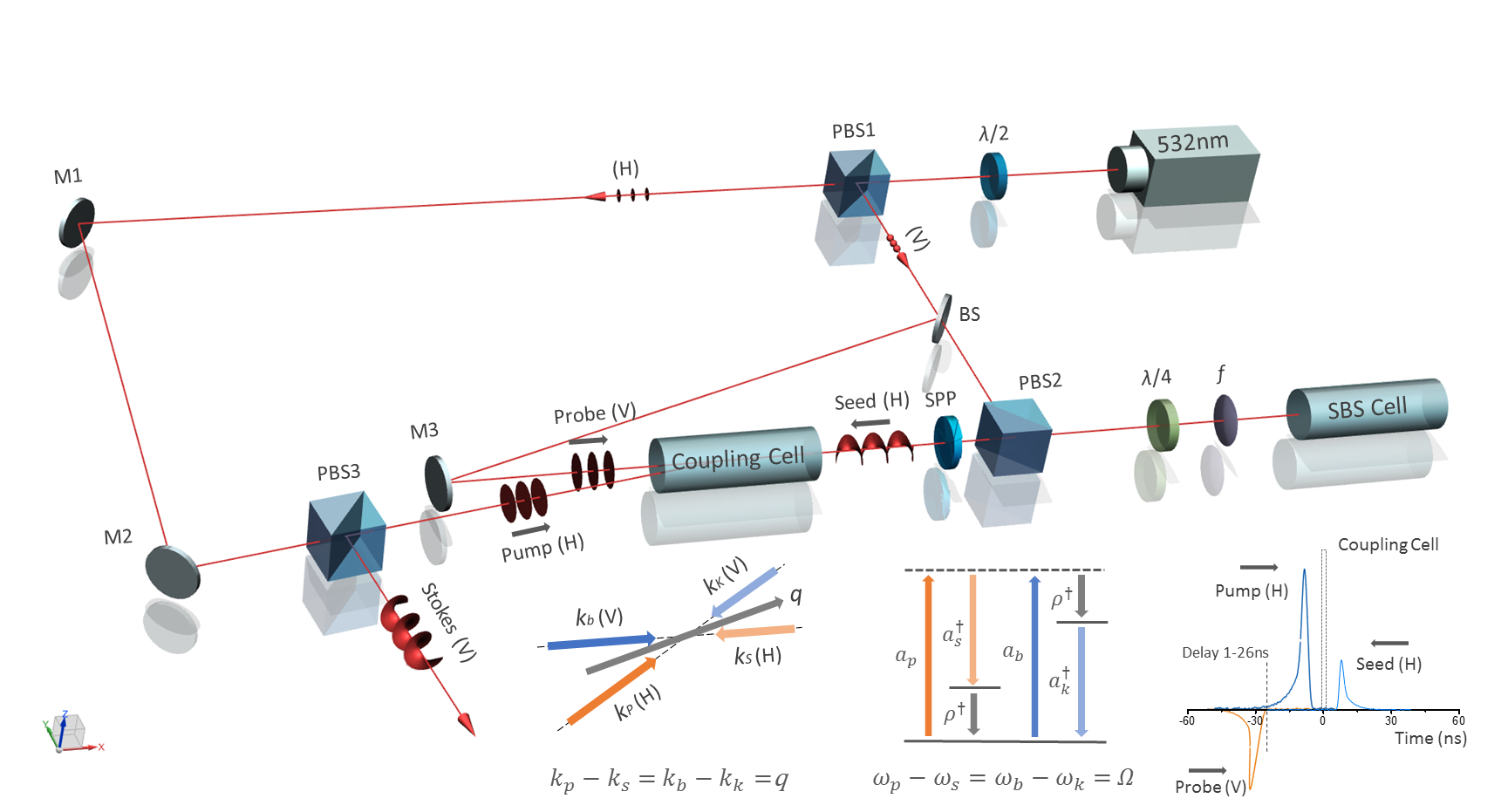
Professor Gao and his research team was sponsored by NSFC (general program No. 11574065), and the following is the schematic diagram of their experimental set-up:
(Link to the article:https://www.osapublishing.org/optica/abstract.cfm?uri=optica-3-2-212;Link
to the PDF:https://www.osapublishing.org/optica/viewmedia.cfm?uri=optica-3-2-212&seq=0
attachment)


